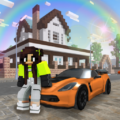
Set in a sprawling voxel metropolis, School Party Craft combines open-ended social simulation with creative building mechanics. Players navigate a cubic city geared toward youth and teenage life, acquiring customizable real estate, driving diverse vehicles, and exploring public destinations such as shopping markets, discotheques, and city pools. Unlike purely decorative building games, it integrates personal interaction, home customization, and active urban exploration into a single sandbox loop.
Voxel Construction and Home Design
The core building loop centers around buying expansive plots and mansions that can be torn down and reconstructed block by block. Construction incorporates a wide range of structural blocks, specialized doors, and functional decorations. Rather than serving purely as static props, interior items such as chairs, beds, and sofas can be directly interacted with to sit or sleep. Players customize spaces with chandeliers, potted plants, and various furniture sets sourced from the in-game market.
City Navigation and Leisure
Beyond private residences, the game maps out an urban environment featuring beaches, restaurants, cinemas, banks, and schools. Movement through these districts is supported by various transportation options, ranging from skateboards, scooters, and motorcycles to tunable cars, alongside scheduled activities such as airplane flights and ship cruises. Leisure spots also host interactive mini-games, including working as a barman in restaurants and clubs, or discovering coin chests placed across the map.
Social Interactions and Paintball Combat
Inhabited by thousands of characters, the city supports active social progression where players add acquaintances to a phone contact list and communicate through SMS messages. Social outings allow groups to visit night clubs to request DJ tracks, dine at restaurants, or stroll through public parks. Action mechanics are introduced through non-lethal paintball warfare, allowing players to recover stolen coins from hooligans using an assortment of paint-shooting arms, including pistols, assault rifles, miniguns, and bazookas.
Technical Configuration and Camera Views
The title incorporates both first-person and third-person camera perspectives to suit different styles of driving, building, and exploring. Gameplay systems account for dynamic time-of-day cycles and shifting weather patterns. Visual and control inputs can be tailored directly in the settings, allowing button layouts to be adjusted to user preference, while the underlying engine accommodates hardware setups operating with at least 1 GB of RAM.


 Roblox
 FPS Strike Ops : Modern Arena
 Subway Surfers
 Tank Busters: Cannon Battle
 Slow Mo Strike: Knives in Time
 Monster Hunter Outlanders